Memorizing Preflop Ranges Without Burning Out: 4 Drills That Actually Stick
Most players know they should memorize preflop ranges. Few have a method that survives a week. Four drills built on active recall, spaced repetition, and interleaving, plus a weekly schedule that combines them.

Every serious player eventually decides this is the week they finally memorize their preflop ranges. They open a chart, print it out, set it next to their screen, and tell themselves the discipline will hold. Three days later the chart is buried under a pile of receipts and the player is back to opening the hands that feel right.
The failure isn't willpower. It's method. Memorization isn't a focus problem; it's a learning-science problem. The way you study determines whether the chart sticks for a year or evaporates by Friday. This post is the literal weekly routine, built on four drills that work the way human memory actually works.
Why Most Preflop Memorization Attempts Fail
The default approach (stare at the chart, then play, then stare again) is the worst possible way to learn anything. Cognitive psychology has known this for fifty years. Three principles drive durable memory, and almost nobody applies them to poker study:
- Active recall beats passive review. Reading a chart over and over feels productive but doesn't make it stick. Trying to recall the chart from scratch (and getting it wrong, then checking) is what builds the neural pathway. The struggle is the point.
- Spaced repetition beats marathon sessions. Twenty minutes a day for five days teaches you more than a single two-hour cram session. The forgetting curve flattens with each spaced exposure.
- Interleaving beats blocked practice. Drilling UTG opens for thirty minutes, then BB defense for thirty minutes, sounds organized. It's worse than mixing the two together, because in a real game the spots come at you mixed, not in blocks.
Every drill below is designed to put one of those three principles to work. The combined weekly routine puts all three to work.
Before the drills, here is a real GTO chart you might be memorizing right now. With WSOP season around the corner, big blind defense against a cutoff open at 40bb effective near the money bubble is one of the highest-leverage ranges in tournament poker, and the kind of spot you will see dozens of times across a series:
|
40bb · BB vs CO open · MTT · ICM near bubble
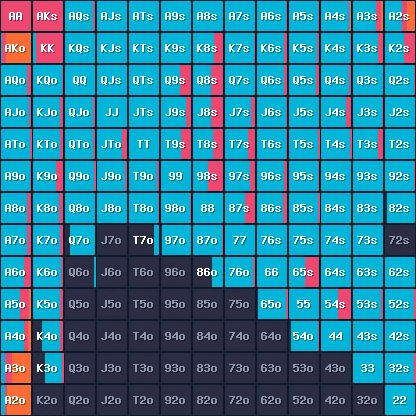
Jam
·
3-bet
·
Call
·
Fold
Cell width = action frequency.
Cell width is proportional to action frequency.
Source: GTO Ranges+ · full 169-combo solve
|
Drill 1: The Pair-Quiz (Active Recall)
The simplest drill, and the foundation everything else builds on. Pick one spot, such as BB facing a UTG open at 30bb effective. For each hand class on the chart, cover the answer, say what you think the right action is out loud (call, 3-bet, fold), then check.
Two rules make this work. First, say it out loud or write it down before you look. Recall in your head is too easy to fake. Second, focus on the hands you get wrong, not the ones you get right. The whole point is to find your blind spots; the hands you already know are noise.
Ten minutes a day, one spot at a time. The GTO Ranges+ trainer is built around exactly this loop. It shows you the spot, you pick the action, the app tells you how the GTO solution mixes. The feedback loop turns a static chart into a quiz.
Drill 2: The Position-Flip (Interleaving)
Pick one hand, for example an offsuit broadway like KQo. Then ask yourself, in random order: what does this hand do under the gun? On the cutoff? On the button? From the small blind? From the big blind facing a button open? Facing a UTG 3-bet?
This drill is harder than it looks. Most players develop position-by-position blind spots: they know their button range cold and their UTG range fuzzy. Forcing the same hand through every position in random order exposes those gaps fast.
The key trick: do this without moving through the chart in order. Shuffle the position cards (mentally or literally), then quiz yourself. The randomness is what makes the recall stick. If you always do UTG, MP, CO, BTN in the same order, you're learning the sequence, not the spots.
Drill 3: The Partner Quiz (Retrieval Under Pressure)
Find a study partner: a friend, a Discord study group, a coach. One of you calls out a spot: "BB versus BTN open, 50bb effective, you have QTo." The other answers cold, no chart, no pause. Then swap.
Three things happen in this drill that you cannot replicate solo. Social pressure forces real-time recall. You can't fake-remember when someone is waiting. The questioner learns by formulating questions. Choosing which spots to ask reveals what they themselves understand. And conversation surfaces the why: not just the what. "Why does KQo flat here?" forces the structural reasoning that turns memorized actions into transferable intuition.
Twenty minutes, twice a week, with the same partner. Within a month you'll both have ranges you can't unlearn.
Drill 4: Time-Pressure Recall (Automaticity)
The final drill is what turns recall into instinct. Set a three-second timer. Spot appears, decide, click, move on. No deliberation, no second-guessing, no checking the chart.
This is the drill that exposes the gap between "I know this" and "I can play this at speed." Most players know their ranges in slow study mode and freeze in live play because the recall isn't automatic yet. The fix is to practice at the speed of the real decision.
Run this against the GTO Ranges+ trainer with your own mental timer. The app's mistake-breakdown reports show exactly which spots keep tripping you up, so each follow-up session targets your real leaks instead of re-drilling what you already know. Five-minute sessions, three times a day. The volume of reps at game-speed is what compresses recall from deliberate to instant.
The Weekly Schedule That Combines All Four
Drills in isolation are useful; combined into a routine they compound. Here's a 25-minute daily schedule that hits all three cognitive principles every session:
- Minutes 0–10: Pair-Quiz on yesterday's weakest spot (active recall + spaced repetition)
- Minutes 10–20: Position-Flip with three random hand classes (interleaving)
- Minutes 20–25: Time-Pressure Recall on a mixed-spot drill (automaticity)
Twice a week, replace one of those sessions with a Partner Quiz. Five days a week, 25 minutes a day, and within a month you have ranges that feel automatic at the table. Not because you tried harder, but because you trained the way your brain actually learns.
Once preflop ranges are automatic, the next leak that eats most players' study time is unstructured solver work. The companion piece on that: 5 Common Solver Study Mistakes That Are Wasting Your Time.
The Mistake That Eats Most People's Progress
If you do one thing differently this week, drop passive review. The phrase "I'm going to look over my charts" is the killer. Looking is not learning. Quizzing is learning. Every minute spent re-reading a chart you could be quizzing is a minute the new neural pathway didn't get built.
The same principle applies to solver review, to studying coaching videos, to reading strategy posts. Whenever you feel the urge to passively absorb information, force yourself to predict the answer before the source reveals it. The struggle is what makes it stick.
Takeaway
Memorization isn't about discipline. It's about method. Active recall, spaced repetition, and interleaving are the three cognitive levers that turn fuzzy chart knowledge into automatic table action. The four drills above are how you pull those levers, and the 25-minute daily routine is how you put them on a schedule that survives a real week.
The GTO Ranges+ trainer is built around exactly this loop. Streaks reward daily consistency so you don't lose a week to a missed session. Mistake-breakdown reports show you exactly which spots keep eating your accuracy. Daily reminders kick in based on when you last studied, and custom saved drill sets let you rotate the spots you want to keep sharp. Open it for ten minutes a day and you'll have ranges in a month that the chart-staring method would never give you in a year.
Practice This Strategy in ThinkGTO
Apply what you've learned with ThinkGTO's GTO trainers and solver tools. Study real scenarios, drill against GTO bots, and build winning habits.
Try ThinkGTO FreeGet the free Solver Vault
Subscribe and get the Solver Vault instantly: 60+ pages of solver-backed Deep Dive breakdowns, yours to keep. Weekly GTO insights follow. Free forever.
No spam, ever. Unsubscribe anytime.
You're in. Here's your pack.
Weekly GTO tips are on the way too. Unsubscribe anytime.
Download your pack