|
ThinkGTO
Think Deeper. Play Sharper.
| |||||||||||||||||||||
Your Nothing Is Not All the Same Nothing | |||||||||||||||||||||
You bet a quarter pot on the flop, overbet the turn, and the big blind called both. Now they check the river with 30.6bb in the middle and you hold air. Most players decide this one way: "I have nothing, so I bet." Solver+ decides it two ways, and on the same river it fires one queen-high hand 100% of the time and checks an ace-high hand 100% of the time. The difference is never the strength of the hand. It is whether the hand can win a showdown, and whether its cards remove combos from the big blind's calling range or from their folding range. | |||||||||||||||||||||
Here is the sort on one river, straight from the new post: | |||||||||||||||||||||
| |||||||||||||||||||||
The pattern held on four different runouts. Bluffs were 24 to 33% of the betting range, never sized under 90% pot, and every surviving bluff held a blocker to what calls: a ten when the straight is QT, an eight when trips are T8, a six when the only straight is 86. The post ends with a six-question river checklist you can run at the table. You can build the blocker reflex against solved spots in Postflop+. | |||||||||||||||||||||
| Read the full breakdown → | |||||||||||||||||||||
Strategy Spotlight: The 15bb Transition Zone | |||||||||||||||||||||
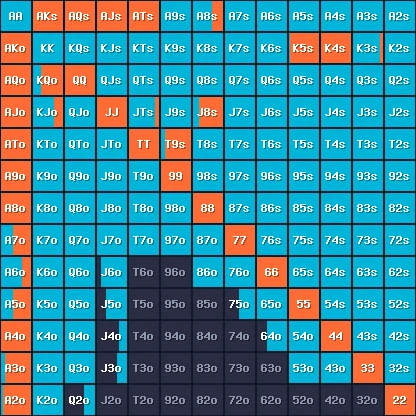
Push-fold charts stop being the whole answer well before you think. Our push-fold guide for every stack depth splits shallow play into zones, and 11 to 15bb is the transition: some hands still call and see flops. The GTO Ranges+ solve for a 15bb, 8-handed, chip-EV table makes that concrete. When the button min-raises and it folds to you in the big blind, you jam 18%, fold 24%, and call 58%. Calling is the majority action. AA flats every time, AK offsuit and the small pairs jam, and hands like K9s, JTo and 65s all call and take a flop. | |||||||||||||||||||||
| |||||||||||||||||||||
The mistake is treating 15bb like 10bb and jamming anything you would not fold. Against a min-raise you are getting a price, and the solve keeps its jam range narrow on purpose. The full hand-by-hand read of this grid is in defending the big blind at 15bb. | |||||||||||||||||||||
Hand of the Week | |||||||||||||||||||||
The spot: 100bb cash. The button opens to 2.5bb, you call in the big blind. Flop K♠ Q♦ 5♣, rainbow. You check, the button bets 1.38bb (a quarter pot) into 5.5bb. You hold J♥ T♥: an open-ended straight draw (any 9 or ace, with the ace side making the nuts) plus a backdoor flush draw. Call or raise? | |||||||||||||||||||||
Per the K-Q-5 deep dive, this is a model check-raise. The button bets this flop with about 76% of its range at the small size because it holds nearly all the strong hands, so the big blind cannot just call and hope. Solver+ has the big blind calling 52%, folding 36% and check-raising about 13% of the time, mostly to 6.2bb. The raising range is sets, two pair, strong Kx, and semi-bluffs with real backup. J♥ T♥ is the best of those: it folds out the button's air now, and when called it has eight outs to a straight plus a backdoor flush to keep barrelling. Raise to 6.2bb. Practise the same decision on a hundred flops in Postflop+. | |||||||||||||||||||||
Tool Tip: Drill Only the Spot That Leaks | |||||||||||||||||||||
Most 3-bet mistakes are not range mistakes, they are one-seat mistakes: your button-vs-cutoff 3-bets are fine and your small-blind-vs-button 3-bets are wide open. GTO Ranges+ lets you fix the one seat instead of drilling everything. Build a custom saved drill from just the 3-bet and 4-bet spots that matter to your game, run it daily (the streak counter keeps you honest), and read the mistake-breakdown report to see which exact spots keep eating your accuracy. Pair it with the ranges in 3-bet and 4-bet ranges that print money and you will know within a week which position is the problem. | |||||||||||||||||||||
| Open GTO Ranges+ → | |||||||||||||||||||||
This Week in Poker | |||||||||||||||||||||
Nick Schulman added the biggest result of an already long career, taking down the Triton Main Event for $3.8 million. A high-roller field, a deep final table, and a player whose game has visibly rebuilt itself around solver-era fundamentals over the last few years. Longevity in this game is a study habit, not a hot streak. | |||||||||||||||||||||
On the tools side, custom preflop ICM solving landed on one of the big desktop solver platforms this week: your own stacks, payouts and bounties, up to nine players, with chip-EV and ICM side by side. The takeaway for the rest of us is that ICM-adjusted preflop ranges are now the baseline, not an advanced topic. The solved ICM and PKO libraries in GTO Ranges+ cover the same final-table pressure without a desktop, and the free ICM Calculator shows the risk premium your exact stacks create. | |||||||||||||||||||||
Put It Into Practice | |||||||||||||||||||||
Train the river decision in Postflop+, pull the exact frequencies for your own runouts in Solver+, and take the 15bb grid above to the table with GTO Ranges+. | |||||||||||||||||||||
| Browse the blog → | |||||||||||||||||||||
| X Instagram TikTok Discord | |||||||||||||||||||||
|
You are receiving this because you subscribed at thinkgto.com. Unsubscribe · ThinkGTO · Think Deeper. Play Sharper. |