|
ThinkGTO
Weekly Digest · 14 to 20 September 2026
| ||||||||||||||||||||
|
This week: the set whose correct play swings from 20% to 91% depending on who opened, and three opening-range numbers we had wrong until we checked them. | ||||||||||||||||||||
Lead StoryHold'em gives you 169 starting hands and a 13x13 grid to put them on. Pot-Limit Omaha gives you 270,725 combinations and no grid that can hold them, which is why PLO ranges get taught as nine hand classes built from pairing and suiting. This week we went a layer underneath that model, using a solved 100bb 6-max game from PLO+. The finding: the class labelled "one pair" contains a hand the button opens 100% of the time and another the hijack opens 0.9% of the time. Aces are the only class position cannot touch, opening every time from every seat. Mid and low pairs are the opposite: rainbow, they are close to unplayable, and the same ranks double-suited open roughly 35 times more often. The pair did not change. The suits did. | ||||||||||||||||||||
Strategy SpotlightWe also rebuilt our preflop opening-ranges article this week against decoded GTO Ranges+ data, and three of its old numbers were wrong. Here is what a solved 6-max 100bb cash game actually opens:
That last row is the one worth your attention. The familiar rule is that the small blind raises or folds and never limps. This solve completes 20.5% of the time. Raise-or-fold is a reasonable simplification, but it is a simplification, not the equilibrium. | ||||||||||||||||||||
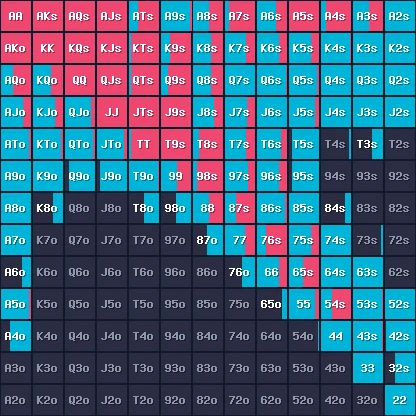
The RangeHere is the other side of those opens: how the big blind defends when the button raises to 2.5bb. It folds 54.9%, calls 31.7% and 3-bets 13.4%. This is a preflop solve from GTO Ranges+, and every one of the 169 cells below is decoded from it rather than sampled.
| ||||||||||||||||||||
Hand of the Week9♥ 7♥ 2♣, 100bb cash. Someone opens, the big blind calls, the big blind checks and faces a 25% pot c-bet. Three sets are possible on this board, and only one of them has a single answer. This one is postflop, so it comes from Solver+ rather than the preflop library above. Here is how often the big blind check-raises each set, by who opened the pot:
Bottom set raises every time no matter who opened. Top set raises almost every time. Middle set is the only one that moves, and it moves a long way: 20% against an under-the-gun opener, 91% against a button opener. Same board, same hand, same bet size. The reason is the range you are raising into. A button opening range is wide and full of hands that continue and pay you off, so middle set becomes a straightforward value raise. An under-the-gun range is tight and strong, so sevens would mostly be raising into better, and calling keeps the opener's whole range in the pot instead. Worth knowing what does not move: pocket eights down to pocket threes never check-raise here against any opener. They are slam-dunk calls. They already beat the unpaired high-card hands doing a lot of the betting, and they keep two outs to a set that coolers an overpair on a later street. Raising folds out everything they are ahead of and bloats the pot against everything they are not. | ||||||||||||||||||||
Tool TipWe rebuilt our final-table push-fold article this week too, and it produced the most counterintuitive number of the week. Two solved 8-handed tables, every seat on exactly 12bb, identical except for the payout model:
ICM makes you a tighter caller and a looser shover. Most players apply the tightening to both and leave the shoves on the table. The free ICM Calculator gives you the risk premium for your own stacks and payouts, which is the number that tells you which side of that you are on. Then Postflop+ drills the decisions until they are automatic. | ||||||||||||||||||||
This Week in Poker
| ||||||||||||||||||||
Put It Into PracticeTwo libraries produced everything above. GTO Ranges+ holds the preflop solves: the opening charts, the defence grid, and the chip EV and ICM push-fold comparison. Solver+ holds the postflop spots, including the check-raise node in Hand of the Week. If you play Omaha, PLO+ carries the ranges behind the lead story, and Postflop+ is where you drill the decisions until they are automatic.
Or read the rest of this week's writing on the blog. | ||||||||||||||||||||
|
X · Discord · Instagram · TikTok · Facebook ThinkGTO by Crafty Wheel Studios. Think Deeper. Play Sharper. |