|
ThinkGTO
Think Deeper. Play Sharper. · Week of July 20–26, 2026
|
This Week's Lead |
The Flop Frequency You Memorized Was Solved for a Range You Are Not Playing
You studied the spot, you know the button c-bets 84% here, and you are still wrong, because Solver+ computed that number for a specific preflop range. Change the range and the whole tree re-solves. On K♠7♦2♣ a tight early-position opening range c-bets 97%, but a wide button range only 84%. On Q♠J♠4♦ it flips: the wide range fires 92%, the tight range just 59%.
Same board, opposite strategy, and the only thing that changed was the range walking onto it. Every preflop deviation you make (a limped button, a flatted 3-bet, a wider open in a soft seat) quietly breaks the flop chart you drilled. The fix is to lock your preflop ranges in GTO Ranges+ so the Solver+ solution actually applies to the range you show up with.
Read the full breakdown →
|
|
|
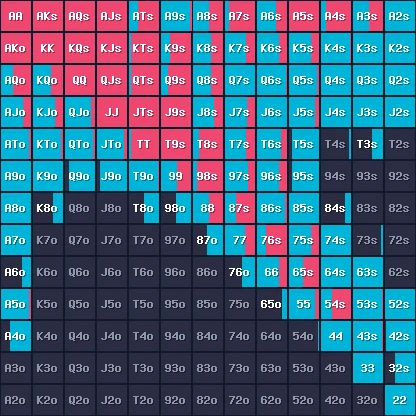
100bb cash · BB defending vs a BTN open · the preflop range every BTN-vs-BB flop solve assumes
Jam
·
3-bet
·
Call
·
Fold
Cell width = action frequency.
Cell width is proportional to action frequency.
|
This is the big blind's real calling range against a button open. Every hand it flats (blue) is a hand that shows up on the flop, which is exactly the range the postflop solve is built around. Change what you defend, and you change every c-bet that follows.
|
Strategy Spotlight |
The Fold That Looks Like a Nit Fold, But Is Not
A short stack jams, it folds to a solid regular with a comfortable stack and a hand the pot odds call a clear call, and they fold anyway. That is not weakness. It is the live stacks sitting behind them. When you cold-call a jam with players yet to act, you are not closing the action: a big stack behind can re-jam, isolate the short stack, and put your chips in a vice.
That threat does not need to fire often to matter. Fold even a modest re-shove risk into the math and the equity you need to cold-call climbs from about 45% into the low 50s, and every hand in that band slides from call to fold. For whoever jammed, those forced folds are free equity a two-player model never shows. The multiway push/fold trees in GTO Ranges+ price it in automatically.
Read: Overlay From the Stacks Behind →
|
|
Hand of the Week |
The Solver Checks Back Pocket Aces on 8♣ 6♦ 4♠
The spot: 100bb cash, button opens, big blind calls. Flop 8♣ 6♦ 4♠, pot 5.5bb. The big blind checks. You have A♠ A♦ in position, and Solver+ says check back 97% of the time.
Meanwhile the smaller overpairs pile into a big bet: QQ bets big 89%, and JJ, TT, and 99 bet big almost always. The strongest hand checks; the weaker ones fire. That inversion is the whole lesson.
Why: a low connected board is where the caller's range lives. The big blind holds the two pair and straight combos (86, 64, 57, 75), so betting aces folds out everything worse and gets action only from the hands that beat you, all while exposing you to a check-raise you hate. Aces are already safe from almost every turn, so they pot-control. The vulnerable overpairs bet big because an overcard can flip them: they charge the draws and deny equity while they are still ahead. Strength pot-controls, vulnerability protects.
Drill boards like this in Postflop+: make the decision, then see the solved answer.
|
|
Tool Tip |
Know Your Downswing Before It Happens
Most players underestimate variance until it is halfway through their bankroll. The free Bankroll Calculator turns the guesswork into a number: plug in your win rate and its standard deviation, and it shows the downswings you should expect to survive at a given stake. Run it before you take a shot, not after you punt three buy-ins wondering if you are broken. You are usually not broken. You are just inside the math.
Open the Bankroll Calculator →
|
|
This Week in Poker |
|
The most iconic trap in poker history, revisited. A strategy channel broke down the final hand of the 1988 WSOP Main Event, where Johnny Chan checked the nuts into Erik Seidel and let him barrel into a made straight, the hand later immortalized in Rounders. The modern lesson holds up: slow-playing works best against a range that is committed to betting for you, which is exactly when a check earns more than a bet.
How players beat themselves at the series. A well-known coach ran through the ways grinders sabotaged their own WSOP: over-registering into too many events, poor game and stake selection, and letting a single cooler wreck the rest of a trip. None of it is a strategy leak. All of it is preparation and discipline, the cheapest edges in tournament poker.
|
|
Keep Sharpening |
|
|
|
|