|
ThinkGTO
Think Deeper. Play Sharper. · Week of July 13–19, 2026
|
This Week's Lead |
Tournament Structures Decoded: How Level Length and Starting Depth Set Your Strategy
A $22 turbo and the WSOP Main Event share the same rules and reward close to opposite skills. This week's post breaks a structure sheet down to the two numbers that matter (level length and starting depth), then shows the punchline with solved ranges from GTO Ranges+: at 60 big blinds the cutoff opens 35.8% of hands with a single 2.3x raise. Drop the same seat to 15 big blinds and entry tightens to 29.2%, now split between min-raises (17.5%) and open-jams (11.7%).
Same seat, same cards, different game. The post includes the side-by-side grids and a 60-second checklist for reading any structure sheet before you register.
Read the full article →
|
|
The other side of that min-raise
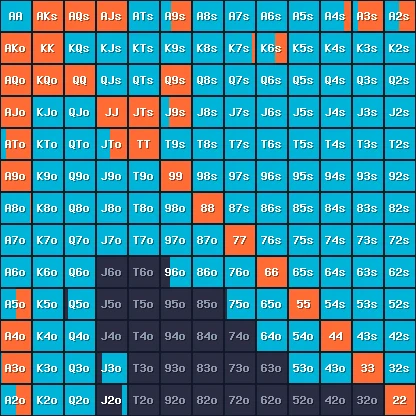
When the cutoff min-raises instead of jamming at 15bb, the big blind gets to punish it. Per the same solved spot in GTO Ranges+, the BB folds just 23.0%, flat-calls 60.5%, and re-jams 16.5%.
The detail worth stealing: AA never re-jams here. It flat-calls 100% of the time to keep the cutoff's whole entry range in the pot, while QQ, KQo, and JTs shove.
|
15bb · BB vs CO min-raise · MTT chip EV
Jam
·
3-bet
·
Call
·
Fold
Cell width = action frequency.
Cell width is proportional to action frequency.
|
Grid: fold / call / jam mix for all 169 hands, from the GTO Ranges+ solve.
|
|
Strategy Spotlight |
Your range picks the bet size, not your hand
Same 100bb button-vs-big-blind single raised pot, two flops. On A♦7♠2♣ the solver c-bets about 70% of the time at 25% pot and almost never bets big (under 3%): the button's range owns the board, so everything bets small, including air. On 8♥7♦6♣ the same ranges check 51% and split the rest between 25% pot and 80% pot, because the caller's range is loaded with two pair and straights.
The hand you hold barely moves; what moves is how your whole range hits the texture. If your sizing tracks your hand strength instead, observant opponents read you like a chart. Build both trees in Solver+ and compare them side by side.
Read: Range-Based Bet Sizing →
|
|
Hand of the Week |
J♥T♥ on K♠Q♦5♣: the model check-raise
The spot: 100bb cash, button opens 2.5bb, big blind calls. Flop K♠Q♦5♣, pot 5.5bb. BB checks, and the button c-bets 1.38bb (25% pot) with 76% of its range: on this static, broadway-heavy board the button holds nearly all the strong hands, so the whole range bets small.
The defense: facing that small bet, the big blind calls 52%, folds 36%, and check-raises 13%. The model check-raise combo is J♥T♥: an open-ended straight draw to the nut end (any ace or nine completes it) plus a backdoor flush draw.
Why it works: the raise attacks a bet the button makes with its entire range, so most of that range has to fold or float out of position on later streets. And when the raise gets called, J♥T♥ keeps arriving on turns with real equity and clean barrel cards instead of praying for showdown. Every frequency above comes from the Solver+ solve in the deep dive.
See the full K-Q-5 breakdown →
|
|
Tool Tip |
Drill one texture family per week in Postflop+
Random-spot grinding teaches slowly because every hand is a new lesson. Instead, pick one texture family for the week (paired boards, K-high broadways, low connected boards), load those flops in Postflop+, make your decision, and check it against the solved answer. Twenty drills a day on one family and the structural logic starts repeating before the week is out. Next Monday, switch families.
Open Postflop+ →
|
|
This Week in Poker |
|
The shot clock argument reaches the Main Event. The WSOP's new shot clock has the community relitigating tanking: most players agree endless tanks are a real problem, and almost nobody agrees the clock is the right fix. Expect this debate to shape how other major series handle it next season.
Tournament rules got a rewrite. Tournament directors gathered in Las Vegas for the TDA Summit and revised several standard rules during the WSOP. The changes are procedural rather than strategic, but expect small differences at your local room over the coming months as floors adopt the new standard.
|
|
Keep Improving |
|
|
|
|