ThinkGTO Weekly Digest · May 25 to 31, 2026 | |||
This Week's Lead Postflop is one decision tree, not three streets.The river leak that costs you the most was always a flop leak with better disguise. The fix is the pot-geometry framework: decide the river goal first, then back-solve the bet sizes that get you there. You can see the full tree visualisation inside Solver+ and drill the back-solve habit one spot at a time in Postflop+. The math in the post lands on three SPR regimes worth memorising. At 100bb single-raised (SPR around 17), geometric commit is impossible, so the solver defaults to small bets and pot-control. At a 100bb 3-bet pot (SPR around 4.5), the geometry returns a flat 58% pot per street across three streets, the sweet spot for clean stack-offs. At a 4-bet pot (SPR around 1.5), the tree collapses to roughly 50% pot over two streets, or a near-shove on the flop. Read the full article → | |||
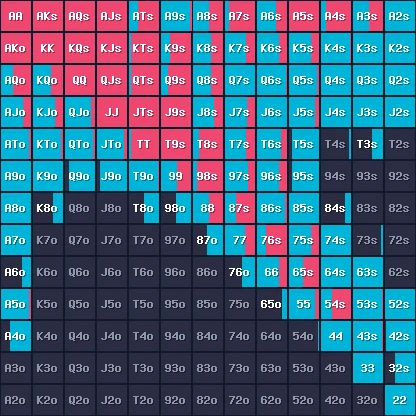
The Spot the Article Back-Solves BB defending vs BTN, 100bb cashThis is the preflop tree behind the 3-bet pot back-solve in the article. The mix tells you which combos are stepping into a 100bb 3-bet pot in the first place, which combos prefer a flat (and a smaller flop SPR), and which combos fold.
Mix at the action node: fold 54.9%, call 1.5bb 31.7%, 3-bet to 7.5bb 13.4%. The 3-bet branch is what the post's geometric sizing applies to. | |||
Strategy Spotlight Bubble math: why your defense range almost halvesWSOP is already underway, so this is the one number to drill between sessions. From middle position at 20bb, a typical cash open of around 22% of hands contracts to roughly 9.5% on the money bubble (77+, ATs+, KJs+, QJs, AJo+, KQo). Hands with marginal postflop playability lose the most value because you cannot afford the variance of seeing flops and committing your stack. The defense side compresses just as hard. Big blind with 20bb facing a 2.5bb button open on the bubble defends roughly 20% of hands: jam 88+, AJs+, AQo+ (about 6%), flat 22 to 77, A2s to ATs, KTs+, QTs+, J9s+, T8s+, 97s+, 87s, 76s, AJo, KQo (about 14%), and fold the rest. By cash-game MDF that looks exploitable. Under ICM it is correct, because the chips you save have higher dollar value than the chips you would win by defending wider. | |||
Hand of the Week CO opens, BB calls. Flop 8♥ 7♥ 6♣.Setup: 100bb cash, CO opens 2.5bb, BB calls. The flop runs out 8♥ 7♥ 6♣. BB checks. What does the preflop raiser do? The mix: The CO checks back over 50% of the range. When the CO does bet, the sizing jumps to 60 to 75% pot at lower frequency. Bet overpairs, sets, and strong combo draws; check overcards without backdoors, weak made hands, and air. The CO's equity drops to roughly 48 to 50%, down from 55 to 58% on a dry high-card board, because BB's flatting range contains 98s, T9s, 65s, suited connectors, middle pairs, and sets, all of which crush low and middle overpairs. Why it matters: This is the inverse of the pot-geometry lesson above. Range and nut advantage flipped to BB, so the solver removes most of CO's bet frequency rather than picking a smaller size. The flop bet is not just a sizing question, it is a frequency question, and connected mid-card boards are the textbook case where checking back is the default with the bulk of the range. | |||
Tool Tip Lock in ICM ranges with daily repsBubble ranges look obvious in a newsletter. They evaporate at 2am on day 3 of a series. The fix is volume, not insight. Inside GTO Ranges+, the trainer's streak counter gamifies daily consistency, the mistake-breakdown reports show exactly which hand classes you keep misclassifying, and daily reminders nudge you back into the spots you have not drilled recently. In-series routine: save a custom drill of 20bb to 30bb ICM bubble spots in MP, CO, BTN, SB, and BB. Run a short session each morning before you head to the venue, let the streak hold you accountable on rest days, and review the mistake report between events to see which positions are leaking the most chips. The goal is not perfection. The goal is to make the contracted bubble range feel as automatic as your cash-game open. | |||
This Week in Poker WSOP in motion and a livestream return
| |||
Build the habit. Pick your starting point.Three apps cover the full GTO study loop. Pick one and run it daily for two weeks.
Or browse the full back catalogue at thinkgto.com/blog. | |||
ThinkGTO Think Deeper. Play Sharper. |