| ThinkGTO | ||||
| Think Deeper. Play Sharper. · Weekly Digest | ||||
Lead Story | ||||
| The button owns a paired board | ||||
| A paired flop freezes most players. On J♠ J♦ 4♣ in a single-raised pot, the button holds almost every jack and the big blind holds almost none, so the solver does not pick and choose. It c-bets 97% of its range for a tiny 25%-pot size, keeps barrelling on the turns that extend its edge (a queen 64%, a third jack 63%), and eases off only when an ace arrives. The big blind cannot fight back by calling. Its only real defense is a polarized check-raise built from trips, full houses, and pure air. | ||||
| You can drill this exact spot against the solved answer in Postflop+, and every frequency here comes from Solver+. | ||||
| Read the full breakdown → | ||||
Strategy Spotlight | ||||
| How wide does the big blind defend? | ||||
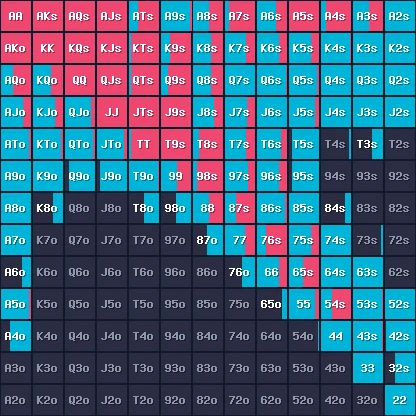
| Before that flop even comes, the big blind faces the decision most players get wrong: how wide to defend against a button open. Fold too much and the button prints by stealing. The answer is to continue with a large, suited-heavy range. Here is the full 100bb 6-max defense against a 2.5bb button open. | ||||
| ||||
| Notice how far down the suited columns the calls run while the offsuit trash folds. Learn that border once and you stop bleeding to late-position steals. Drill the full cash and tournament range library in GTO Ranges+. | ||||
Hand of the Week | ||||
| 9bb on the bubble: jam, do not raise | ||||
| You are in the cutoff with 9 big blinds, one spot off the money, holding A♠ 7♠. The instinct is to min-raise. At this depth on the money bubble that is a leak: a raise commits too much of your stack and leaves you guessing when a cover jams over the top. The solver plays this seat jam-or-fold. It open-shoves 18.5% of hands and open-raises just 4.9%. A suited ace is a clean shove that takes the blinds and antes now while denying everyone behind a cheap look. | ||||
| See the whole bubble table → | ||||
Tool Tip | ||||
| Minimum Defense Frequency, in one tap | ||||
| When you face a bet, minimum defense frequency (MDF) tells you how often you have to continue so a pure bluff cannot profit automatically. Against a 25%-pot bet, MDF is 80%. Against a pot-sized bet it drops to 50%. It is the anti-bluff baseline you adjust from once you read how value-heavy your opponent actually is. Our free MDF Calculator gives you the number for any bet size instantly. | ||||
| ||||
This Week in Poker | ||||
| Around the poker internet this week, the theme was discipline. Creators kept breaking down big laydowns (yes, even folding a straight when the runout screams trap) and hammering the point we make constantly: trimming your opponent’s range street by street beats hero-calling on a hunch. Thin-value threads were everywhere too, a good reminder that a lot of win rate hides in the river bets most players skip. | ||||
Put It Into Practice | ||||
| That is the week. Make your decision on the board, then check it against the solved answer. | ||||
| Get Postflop+ → | ||||
| or read the full deep dive on the blog. | ||||
| X · Instagram · Discord · TikTok ThinkGTO · Think Deeper. Play Sharper. Unsubscribe |