|
ThinkGTO
Think Deeper. Play Sharper.
| ||||||||||||||||||
The Overbet Does Not Need the Nuts | ||||||||||||||||||
Most players save the overbet for two hands: the nuts and pure air. Top pair gets a comfortable half-pot bet, because "you do not want to blow them off the hand". Solver+ disagrees. Button opens, big blind calls, flop K72 rainbow, small c-bet, call. A brick 5 lands on the turn and the big blind checks. KQ bets 135% of the pot 91% of the time. KJ does it 82%. K9, the same top pair with a worse kicker, checks back 93% of the time. | ||||||||||||||||||
The line sits at the ten. The share of each top-pair class that fires the 135% overbet on a brick turn, on two dry flops: | ||||||||||||||||||
| ||||||||||||||||||
Share of each hand class that bets 135% pot on the turn after a 25% pot c-bet and a call. BTN vs BB, 100bb cash. Source: Solver+. | ||||||||||||||||||
The reason is the caller's range. The big blind 3-bet AK and KK before the flop, so the top pairs it can call a big turn bet with are KJ, KT and K9. KQ beats all of them. K9 is behind most of them, so it checks and keeps the pot small. Then the turn card moves the line: an ace turn lifts the button's overbet frequency from 19% to 32% and hands it to AQ, AJ and AT, while every Kx becomes second pair and checks. A pairing 7 collapses it to 6%, trips only. Full tables for K72, A94 and the connected T86 board, where an overcard does the opposite, are in the post. | ||||||||||||||||||
| Read the full breakdown → | ||||||||||||||||||
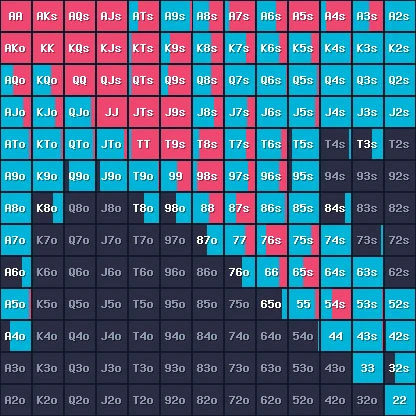
Why can the big blind not have KK or AK on the turn? Because it 3-bet them. This is the big blind's full response to a 2.5bb button open at 100bb, from GTO Ranges+: KK, AKs, AKo and AQs 3-bet every time, while KJo calls 72%, KTo calls 92% and K9o calls 100%. Those calling kings are the top pairs an overbet gets paid by. | ||||||||||||||||||
| ||||||||||||||||||
Big blind vs button open, 6-max 100bb cash. Each cell shows the fold / call / 3-bet split. Source: GTO Ranges+. | ||||||||||||||||||
Strategy Spotlight: ICM Makes You Jam Wider, Not Tighter | ||||||||||||||||||
"Play tighter under ICM" is half right, applied to the wrong half of the strategy. GTO Ranges+ solves two 8-handed tables with every seat on exactly 12bb, identical except for the payout model. At chip EV the button jams 26.1% of hands. At an ICM final table it jams 41.8%. The reason is on the other side of the table: facing that jam, the big blind calls 26.6% at chip EV and only 8.5% under ICM, because the caller is the one risking elimination for a thin edge. Once the blinds fold more than nine times in ten, the right response to all that fold equity is to shove more. | ||||||||||||||||||
The premiums tell the rest of the story. At chip EV the button does not jam aces at all: AA limps 97% of the time, KK 90%. Under ICM the limp disappears, aces and kings raise small to 2bb, and queens through nines are jammed outright. Both grids, all 169 hand classes, are in Final Table Push-Fold Charts for Every Stack Depth. | ||||||||||||||||||
Hand of the Week: A♠ K♦ in a 3-Bet Pot | ||||||||||||||||||
The spot: 100bb cash. The button opens to 2.5bb, you 3-bet to 11bb from the big blind with A♠ K♦, the button calls. Pot 22.5bb, 89bb behind. Flop 9♠ 7♥ 4♦. You are out of position with two overcards and no draw. You act first. C-bet? | ||||||||||||||||||
Solver+ says no. AKo checks 91% of the time on this flop. Your range as a whole checks 48%, bets 35% pot (7.88bb) with 22% and bets 90% pot (20.25bb) with 30%. The big bet belongs to the vulnerable overpairs: JJ and TT fire 90% pot 93% of the time, QQ 82%, because they are ahead now and hate every overcard. AA checks 70%, it has far less to protect against. Ace-king has nothing to protect and little to get called by, so it checks and sees what the button does with its wide calling range. | ||||||||||||||||||
Compare the same hand on A♥ 8♦ 3♣: the big blind bets 35% pot with 96% of its range, AK included, because an ace-high flop crushes the button's calling range and the small bet taxes all of it. Same hand, same pot, opposite action. The board decides, not the two cards. Postflop+ deals you these 3-bet pot spots and shows the solved answer after each decision. | ||||||||||||||||||
Tool Tip: Free GTO Preflop Charts | ||||||||||||||||||
The standard 100bb opening chart is wrong in the two formats where most live and tournament hands are played. Our free GTO preflop charts hub covers them: MTT opening ranges at 40bb (8-max, chip EV) and raise-first-in ranges for 9-max live and 6-max cash at 200bb. Each chart folds every position into one 13×13 grid, coloured by the earliest seat that opens the hand, so from the cutoff you open every cell coloured cutoff or earlier. Striped cells are mixed opens. Print it, or save it as a PDF for the drive to the card room. | ||||||||||||||||||
The charts are a snapshot. The full trees, 3-bet and ICM ranges for every position and stack, plus a trainer with streaks and mistake-breakdown reports, are in GTO Ranges+. | ||||||||||||||||||
| Open the preflop charts → | ||||||||||||||||||
This Week in Poker | ||||||||||||||||||
Adrian Mateos held off a last-event charge to claim the Poker Masters Purple Jacket, the series points title for the best overall performance across the high-roller schedule. On the festival calendar, the World Poker Tour announced a return to the Venetian with a $2 million guaranteed main event, and the RunGood series is heading to The Lodge in San Antonio next month. | ||||||||||||||||||
Two separate strategy pieces this week landed on the same theme as our lead: overbetting without the nuts, and what top pair should do on a good turn card. The population still under-uses the big sizing with one pair. A grinder who ran $2,500 into $10,000 in six days made a related point in an interview: today's $11 field would have been top-five players twenty years ago, and the edge now comes from the spots the field still plays by feel. Turn sizing is one of them. Solver+ has the exact runout. | ||||||||||||||||||
Put It Into Practice | ||||||||||||||||||
Train turn sizing against a GTO opponent in Postflop+, pull the solved runout in Solver+, or study the preflop library in GTO Ranges+. | ||||||||||||||||||
| Browse the blog → | ||||||||||||||||||
| X Instagram TikTok Discord | ||||||||||||||||||
|
You are receiving this because you subscribed at thinkgto.com. Unsubscribe · ThinkGTO · Think Deeper. Play Sharper. |