| ThinkGTO Think Deeper. Play Sharper. | |
| A big welcome to everyone who joined this week. We packed this issue with extra value: a brand new final-table ICM breakdown built on real solver data, a short-stack hand of the week, and three free strategy packs at the bottom in case you missed them last week. Let us get into it. | |
Lead Story | |
| Final Table ICM, Seat by Seat. Every preflop chart you have drilled assumes everyone is the same depth. Real final tables are not. We decoded a solved eight-handed table from GTO Ranges+ with stacks from 10bb to 35bb and read all four decisions off it: opening, three-betting, rejamming, and open-jamming. | |
| The chip leader opens 38.2% from the cutoff while the flat chart says 27.1%, because it risks chips, not its tournament life. The 10bb button stops raising and open-jams 26.7% instead. And the short stacks rejam over an open two to three times more often than the chart suggests, while the deep covered stacks do the three-betting. Two side-by-side range grids show exactly which hands move. | |
| Read the full breakdown → | |
The Grid | |
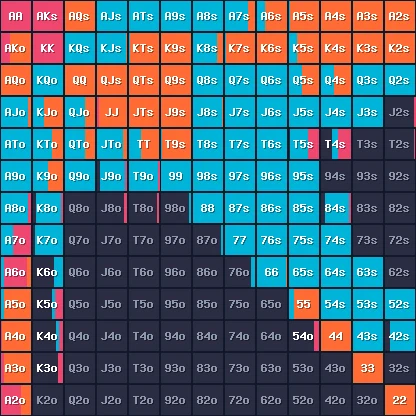
| Here is the flip side of that table: how the big blind should defend when a 25bb final-table button min-raises into it. Fold, flat, three-bet, or ship, cell by cell, straight from GTO Ranges+ ICM data. | |
| |
Strategy Spotlight | |
| Away from tournaments for a moment. One idea separates players who guess bet sizes from players who know them: your entire range picks the size, not your hand. On a given board you choose a sizing for the whole range, then fill it with the right mix of value and bluffs, so a small stab and a big polarised bet each carry a balanced set of hands. Pick the size by hand strength and a thinking opponent reads you instantly. You can watch the same board split into small and large sizings in Postflop+ and build the tree yourself in Solver+. | |
| Why your range picks the size → | |
Hand of the Week | |
| 10bb button, folded to you, A8o. The deep-stack instinct is to min-raise and play a flop. At 10bb under final-table ICM that is a leak. The solved short-stack strategy ships all-in with A8o 100% of the time, and never min-raises it. A 10bb open already commits most of your stack to a fold, so the raise surrenders fold equity for nothing. The jam denies the reraise, pressures two blinds who are terrified of busting before shorter stacks, and A8o dominates the weaker aces that call. Same stack, one rank lower in playability: K9o min-raises 100% and never jams. The short-stack menu is its own game. | |
Tool Tip | |
| With the WSOP Main Event final table set, deal talk is everywhere. Our free ICM Deal Calculator shows what a fair chop actually looks like: enter the stacks and payouts and it splits the remaining prize pool by each player's real equity, not by chip count. It is the fastest way to see why the chip leader at a final table is worth far less than their stack suggests, the same math that drives every range in today's lead story. | |
| Open the ICM Deal Calculator → | |
This Week in Poker | |
| The August Nine are set. The 2026 WSOP Main Event has reached its final table, with the usual mix of short stacks looking for a double and chip leaders sitting on real ICM leverage. If you want to follow along and actually understand the folds, the lead story above is the map. | |
| Coaches are circling ICM too. A new four-part series making the rounds this week lands on a point worth repeating: ICM can make aggression more important, not less. When you cover an opponent by a lot, chip EV already pushes you toward aggression, and ICM adds another layer on top. That is exactly the chip-leader behaviour our decoded table shows. On the cash side, the live $1/$2 and $1/$3 discussion stayed loud, a reminder that against predictable pools, exploiting repeated mistakes still beats perfect theory. | |
Free Bonus · Your Strategy Packs | |
| A gift for reading, and a second chance if you missed these last week. Three PDF packs, no gate, direct downloads. Save them to your phone and study between sessions. | |
| |
| |
| |
Put It Into Practice | |
| Drill the ICM ranges from today's lead in GTO Ranges+, read more on the blog, or come talk hands with us on Discord. | |
| Get GTO Ranges+ → | |
|
X ·
Instagram ·
TikTok ·
Discord ThinkGTO · Think Deeper. Play Sharper. You are receiving this because you subscribed at thinkgto.com. Unsubscribe |