|
ThinkGTO
Weekly Digest · 7 to 13 September 2026
| |
|
This week: one solved knockout final table where the biggest stack plays twice as many hands as the seat two to its right, and does it by calling. | |
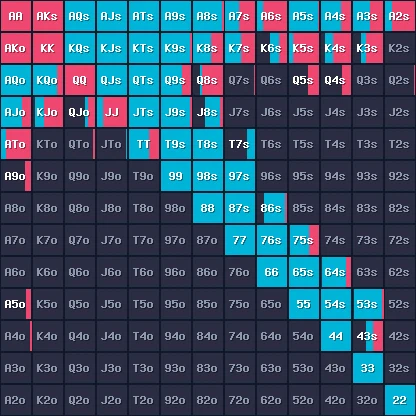
Lead StoryProgressive knockout tables break the chart you memorised, and this week we worked out exactly how. We pulled one solved PKO final table from GTO Ranges+ and read the same decision from three different seats. In that spot the bounty on the opener's head pays more than four times the next pay jump. The button, which covers every player at the table, responds to an early open with 24.3% of hands. The hijack, with two bigger stacks behind it, plays 13.4%. Same open, same table, same tree. The part that surprised us: the button adds nearly all of that extra volume by flat calling, not 3-betting. Calling keeps two covered blinds live behind, and those are the bounties it can actually collect. | |
The RangeHere is the button's full range in that spot, all 169 combos, decoded from the solve rather than sampled.
| |
Strategy SpotlightA related idea worth internalising: your range advantage sets your c-bet frequency, not the board texture on its own. Two flops from Solver+, both 100bb 6-max single-raised pots. On A-K-7 rainbow the cutoff bets 81% of the time, mostly for a large size, because it holds nearly every top pair, two pair and set that the board makes. Move to T-8-5 with an under-the-gun raiser and the same player checks 40% of its range. The tell is which hands do the checking. On T-8-5 the solver checks pocket aces 73% of the time and ace-king 88%. Those are not weak hands. They are hands that do not want to build a pot against a caller whose range is full of tens, eights, nines and suited connectors. | |
Hand of the WeekK♠ Q♦ 5♣, 100bb cash, button opens and the big blind calls. Flop pot 5.5bb. This is the cleanest range-advantage board in hold'em. The button opens wide and arrives with AK, AQ, KQ, KJ, QJ, every broadway Kx and Qx, plus the overpairs. The big blind 3-bet most of its AK and KK preflop, so its calling range gets here capped: it can have a king, it can rarely have the best one. So the button does not choose between betting good hands and checking bad ones. Per the deep dive it bets 25% pot at 75.9%, bets 80% pot at 18.3%, and checks only 5.8%. That is a 94% c-bet, and the small size is the default rather than a compromise. Facing the 25% bet the big blind calls 51.8%, folds 35.6% and check-raises 12.6%. The model check-raise is a hand like J♥ T♥: an open-ended straight draw to the nut end plus a backdoor flush, which is exactly the equity that can fire again on a later street. Against the 80% size the price stops being a discount, and the big blind folds about 55% instead. | |
Tool TipIf the two sections above landed, the next step is building the ranges yourself instead of reading about them. Our free Poker Range Calculator does it in the browser, no signup.
Try it on this week's example. Build a capped big blind calling range, build a button opening range, then run them on K-Q-5 and watch where the nutted combos sit. To then drill the decisions until they are automatic, Postflop+ puts you in the spot and grades the line. | |
This Week in Poker
| |
Put It Into PracticeEvery range in this email came out of the same library. GTO Ranges+ carries the PKO, near-bubble and final-table solves alongside the chip-EV charts to compare them against, so you can check any of these numbers for your own stack configuration.
Or browse the rest of the week's writing on the blog. | |
|
X · Discord · Instagram · TikTok · Facebook ThinkGTO by Crafty Wheel Studios. Think Deeper. Play Sharper. |