|
ThinkGTO
Think Deeper. Play Sharper.
| |||||||||||||||
You Never Fold a Suited Hand Here | |||||||||||||||
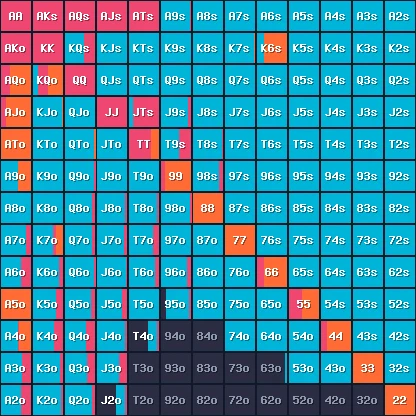
Here is the cleanest rule we have found in a preflop solve. Against every open from UTG to the button, at every stack depth from 15 to 40bb, the big blind in GTO Ranges+ folds zero suited hands and zero pocket pairs to a single open. Every fold is offsuit. At 40bb against UTG, 72s calls every time while A2o folds every time. | |||||||||||||||
What moves is the offsuit fold line, and it moves with the opener. Against the button, the big blind defends over 80% of hands at every depth from 25 to 40bb. Against UTG it shrinks as stacks get deeper: | |||||||||||||||
| |||||||||||||||
Share of all hands the big blind defends (call, 3-bet or jam). MTT chip EV, 8-max, 1bb BB ante. Source: GTO Ranges+. | |||||||||||||||
The other shift is how you get aggressive. Against the button, about one hand in five plays back at every depth, but the form changes: mostly jams at 25bb, a mix at 30 to 35bb, and only small 3-bets at 40bb. 22 jams at 25bb and flat-calls at 40bb. Here is the full 30bb grid against the button: | |||||||||||||||
| |||||||||||||||
| Read the full article → | |||||||||||||||
Strategy Spotlight: The River Jam Is Almost Never the Draw | |||||||||||||||
The straight draws miss, you bet the river, and the big blind check-raises all-in. Most players put them on a busted draw. On three rainbow runouts in a 100bb button vs big blind pot, Solver+ says the missed open-enders check-raise the river exactly 0% of the time. They lead the turn instead, or fold when they get there. | |||||||||||||||
The big blind still check-raises about 17 to 19% of the time, almost always all-in. That range is sets and two pair plus a few weak pairs holding a card from the board. So the question is not "is it a draw?" but "how many weak-pair bluffs can this board hold?" Train the read in Postflop+, or read the full river check-raise breakdown. | |||||||||||||||
Hand of the Week: One Draw, Two Answers | |||||||||||||||
The spot: 40bb tournament, 9-handed with antes. The button opens and you defend the big blind with a suited 6-5. Pot 6.1bb, 37.7bb behind. Flop 8♥ 7♦ 3♣: you have an open-ended straight draw. You check (the big blind checks 98.8% here) and the button bets. | |||||||||||||||
Your play depends on the size. Solver+ has the button checking 33%, betting a small 1.83bb 24% and a big 4.27bb 43%. Against the small bet, 6-5 suited check-raises to 5.22bb 83% of the time. Against the big bet it just calls, 100%. | |||||||||||||||
Why? Against the small bet, a raise builds a pot your draw can win two ways: by folding out the button's air now or by hitting. The big blind raises 25% of its whole range against that size. Against 4.27bb, a raise to 12.17bb puts a third of your stack in with a draw, and the big blind's total raise rate drops to 7%. Your draw would rather see the turn cheaply. | |||||||||||||||
Tool Tip: The Bet Size That Gets Stacks In | |||||||||||||||
That 4.27bb c-bet is not random. Put the spot into our free Geometric Sizing Calculator: a 6.1bb pot, 37.7bb behind, three streets. It returns 68.6% pot on every street: 4.2bb on the flop, 9.9bb on the turn, 23.6bb on the river, and you are all-in. The big c-bet in Solver+ is almost exactly the geometric flop bet. | |||||||||||||||
Run the same numbers at 100bb (5.5bb pot, 97.5bb behind) and the geometric size jumps to 115.8% pot. It is the same reason 40bb pots play so differently: one big bet per street is enough to get everything in. | |||||||||||||||
| Open the calculator → | |||||||||||||||
This Week in Poker | |||||||||||||||
A chip and a chair, for real. Justin Vaysman was down to a fraction of a big blind with five players left at a Poker Masters final table and came back to win the event, his first PokerGO Tour title. A good reminder that a short stack still has equity, and that the spots you pick when you are short are the ones that decide it. | |||||||||||||||
WSOP Paradise moves. The December series in the Bahamas is heading to a new venue this year, with more affordable buy-ins aimed at mid-stakes players. If it is on your calendar, the big blind defense numbers above are exactly the depths you will spend most of your day at. | |||||||||||||||
Put It Into Practice | |||||||||||||||
Drill the BB vs UTG and BB vs BTN ranges at your usual depth in GTO Ranges+, train the flop that follows in Postflop+, and check any spot in Solver+. New posts land on the blog every week. | |||||||||||||||
| Browse the blog → | |||||||||||||||
| XInstagramFacebookTikTokDiscord | |||||||||||||||
|
You are receiving this because you subscribed at thinkgto.com. Unsubscribe · ThinkGTO · Think Deeper. Play Sharper. |